

Aug. 8, 2024
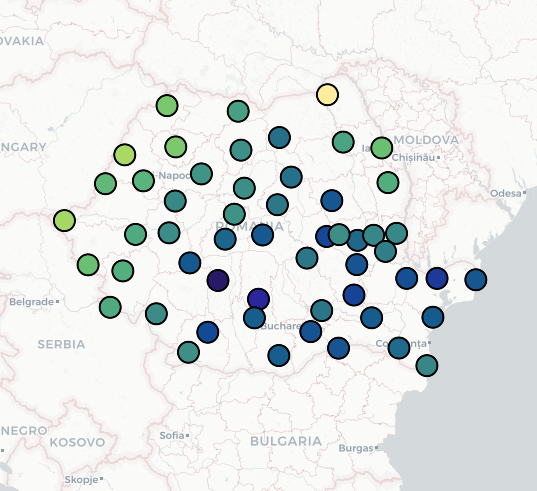
Water vapors play a central role in the Earth’s atmospheric system, shaping weather patterns and influencing long-term climate variability. Real-time monitoring of Integrated Water Vapor (IWV) from Global Navigation Satellite System (GNSS) observations can improve the understanding of atmospheric dynamics. GNSS-derived IWV is particularly valuable for tracking rapid moisture variations associated with extreme weather events, including intense rainfall and flash floods. Moreover, they can serve as reference points for validating satellite observations and contribute to enhancing the performance of numerical weather prediction models and climate analyses.
Continuously Operating Reference Station (CORS) networks are systems of GNSS base stations that provide high-accuracy, 24/7, 3D positioning data, usually transmitted in real-time (RTK) via the internet.
The analysis of GNSS data obtained from CORS networks includes modeling deterministic signals (e.g., annual and semi-annual) and analyzing stochastic noise present in the time series of positions.
Seasonal signals, caused by factors such as soil thermal expansion, atmospheric and hydrological loading, or tropospheric variations, are essential for evaluating station dynamics and understanding associated geophysical processes.
As part of the REACTIVE subproject, INCDFP provides real-time IWV GNSS data displayed in monitoring dashboard: https://reactive.infp.ro/events/gnss-iwv.php
Check also their Environmental Events and Atmospheric Monitoring application: https://eeam.infp.ro/#home