


The Act4DEutrophication project addresses the enhancement of resilience to climate change and biodiversity monitoring in the area of freshwater lakes, with a focus on coastal environments and the neighborhood of Sweetwater Lakes.
The Ovidius University of Constanta platform combines satellite data and in-site measurements for mitigation of the eutrophication in the Siutghiol and Tăbăcăriei lakes (Constanța). Developed methods are extended to other freshwater lakes, such as Bicaz Lake.
COASTAL AREAS, LAKES, AND CLIMATE CHANGE
Understanding and managing eutrophication in freshwater lakes is a growing challenge at the intersection of climate change, human pressure, and ecosystem resilience. Eutrophication problems are expected to intensify as a result of climate change, which distorts interactions in meteorological factors, water temperatures in lakes and estuaries, and nutrient availability. The Fifth Global Environment Outlook (GEO-5) reports that more than 40% of water bodies all around the world suffer from different levels of eutrophication.
A system-of-systems approach can serve as a reference model for climate change adaptation. By integrating hydrodynamic, biogeochemical, climate data, and satellite observations, a coherent modeling workflow can be created for the lakes under study.
CASE STUDY - MAIN SITE
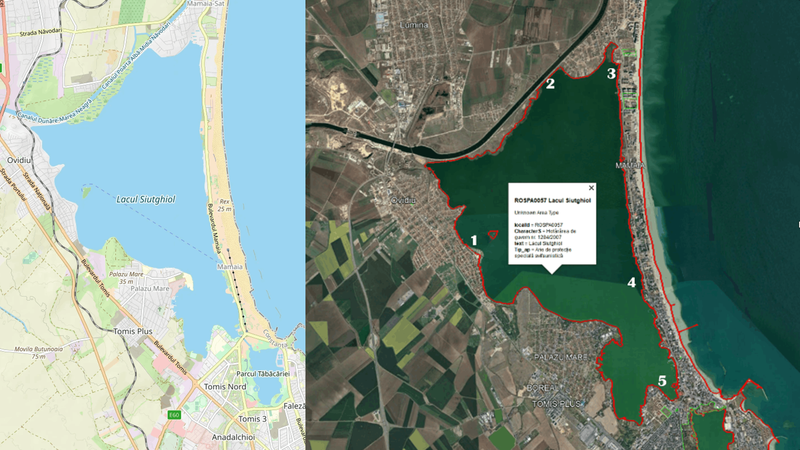
Siutghiol Lake, located on the Black Sea coast, north of the city of Constanța, serves as a test site for integrated ecosystem modeling in the Act4DEutrophication specific project. Together with Tăbăcarie Lake, they form a hydromorphological unit with surfaces of approximately 19 km² and 0.98 km², respectively. Siutghiol, a former marine lagoon separated from the Black Sea by a narrow sandbank, is a unique freshwater ecosystem shaped by limestone geology, which gives it its characteristic milky appearance, hence its name, of Turkish origin.
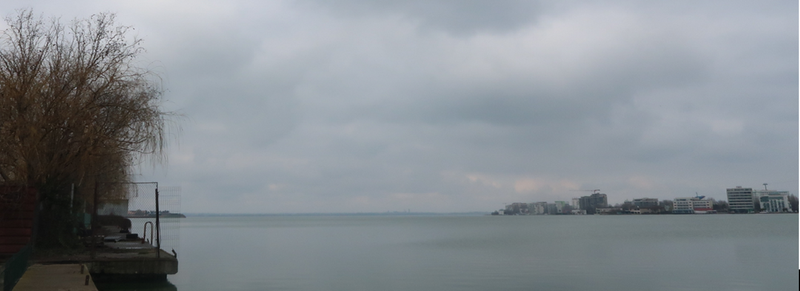
Nowadays, the lake is increasingly affected by climate change through a mix of factors, combining standard freshwater and also coastal influences (due to the proximity to the sea). Rising temperatures and altered precipitation patterns are intensifying eutrophication, promoting harmful algal blooms for extended periods and reducing oxygen levels, which place important pressure on aquatic biodiversity. At the same time, coastal-related stressors, such as changes in water circulation, further disrupt its ecosystem.
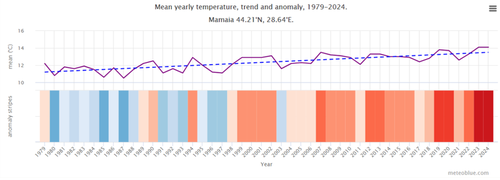
The figure below displays the mean yearly evolution of temperatures (1979-2024) in the Mamaia area, on the east side of the lakes, with the linear increase of recent years clearly evident.
Suitghiol and Tăbăcăriei Lakes are also subject to anthropogenic pressure from their proximity to large tourism facilities, urban expansion, agriculture, and related industries in their surroundings. Although a protected natural area under the European Natura 2000 Birds Directive network—ROSPA 0057—Lake Siutghiol has not benefited from a management plan ensuring the conservation of its avifauna biodiversity.
Some of the main activities during the project implementation have comprised:
- In situ water sampling campaigns on Suitghiol lake
- Modeling effects of lake nutrients and time series study of satellite spectral indices
- Permanent contact with local authorities, NGOs and other interested bodies inside a Living Lab for climate change awareness
DATA AND METHODS - Examples:
In-situ sampling provides accurate, ground-truth data on nutrient concentrations in lakes, while models and simulations help to observe trends, identify drivers, and assess future scenarios under changing climate conditions for eutrophication.
Water Sampling Campaigns
Campaigns for water sampling were performed during the project implementation to analyze water physico-chemical characteristics. Five main monitoring points for data collection were chosen to cover the most important areas where eutrophication can occur in lake Suitghiol.
Sampling (phytoplankton and zooplankton) took place clockwise along the Suitghiol contour (P1 – Ovidiu, P2 – On the Breakwater, P3 – Scoica Land, P4 – Debarcader Rex, and P5 – Faculty of Pharmacy) and was coordinated as close as possible with the passage of the Copernicus Sentinel II satellite. On-site weather impressions, temperature measurements, avifauna, and general ecological observations were also included at each location.
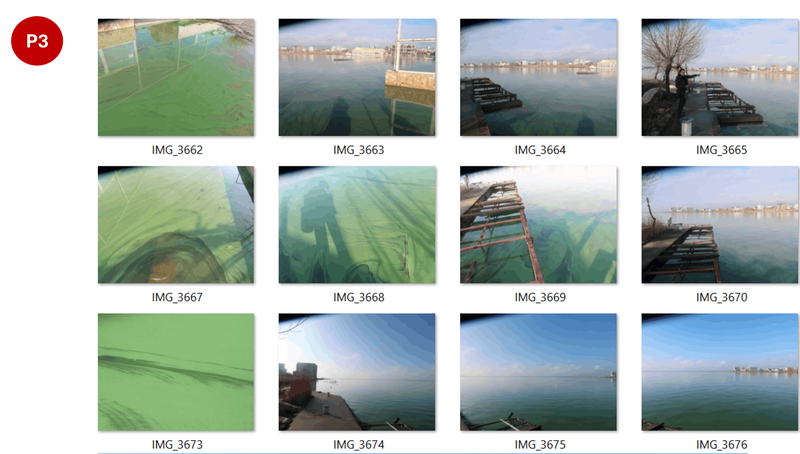
The above photos, taken on 26 January 2025 near observation point 3, show the lake water highly eutrophic at the shore, with a green hue and visible Microcystis flocs. Formalin-preserved samples were conditioned for sorting, and live Microcystis samples were also collected.
Aquatic systems modeling—Simulations and satellite spectral indices
Eutrophication occurs usually when high concentrations of nutrients, such as nitrogen and phosphorus, are present in the water. Modeling the effects of parameters linked to climate change on the nutrients' balance in lakes is essential. For this, the QWET toolbox, a QGIS plugin interface that supports scenario-driven implementations based on meteorological data, inflow–outflow estimates, nutrient loads, and lake bathymetry, was used as a starting point.
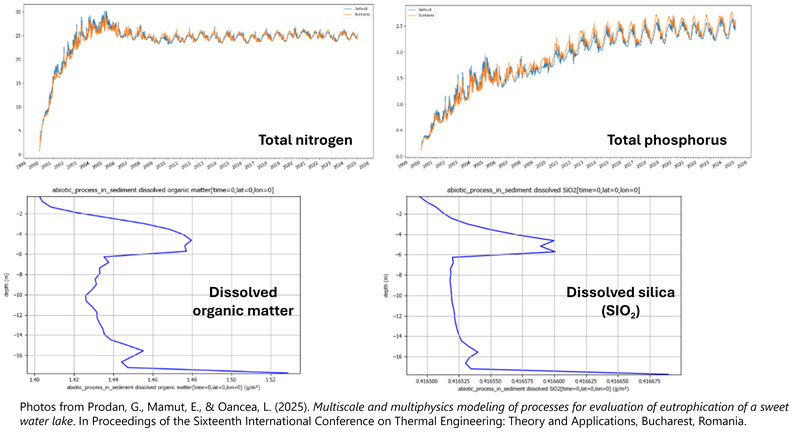
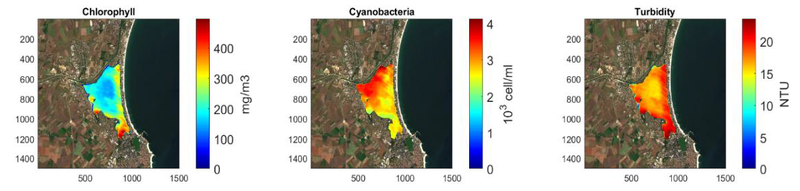
Moreover, satellite-derived spectral indices enable large-scale, continuous monitoring of water quality and ecosystem dynamics. Complementary to in situ measurements, the evolution of biochemical parameters based on Sentinel-2 multispectral satellite imagery has been studied. This offers present and past trend analysis on the entire surface of the lake. The image below highlights derived products for chlorophyll-a (key proxy for phytoplankton biomass), cyanobacteria, and turbidity levels.
SOCIETAL IMPACT
The Act4D-Eutrophication project develops a holistic approach to address the adaptation to climate change of the communities located in the neighborhood of freshwater lakes and coastal areas. Algal blooms that reduce oxygen levels in the water are a mark of eutrophication, leading to anoxic conditions that degrade water quality and can trigger mass mortality of aquatic organisms.
On its societal impact, eutrophication can affect the availability of safe water resources, pose risks to human and animal health, impact biodiversity, or reduce the recreational and economic value of water bodies, making it a critical environmental concern.
DELIVERABLES
The aim of Act4D-Eutrophication specific project is the defining and validation of a methodology and a set of procedures for monitoring the effects of climate change, their detailed analysis, and the collaboration with local communities for the co-creation and implementation of measures to adapt the communities to the effects of climate change and the protection of biodiversity in sweet-water lakes in Romania.
- Description of work packages
- D2-2.1 Report on National, International and Global data sources, including satellite data regarding the Climate Change impact on the eutrophication of sweet-water lakes and Black Sea West coast waters
- D2-3.1 Report on hazards and risk analysis, risk characterization, prevention and mitigation methodologies of Climate Change impact on the eutrophication of sweet-water lakes and Black Sea West Coast waters. Case study on Siutghiol lake
- D2-4.2 Report on co-creation process for adapting to climate change. Case study Co- design of solutions for reversal of eutrophication (d-eutrophication) in the Siutghiol lake
LIST OF PUBLICATIONS
The Act4DEutrophication webpage contains more details on the objectives of the specific project, publications, living lab meetings, hackathons, and other dissemination activities.